This energy opportunity already outpaces solar and nuclear — and the boom is just getting started.
Listen to the audio version of this article (generated by AI).
Editor’s Note: The U.S. stock market and the InvestorPlace offices, including Customer Service, will be closed tomorrow, June 19, for the Juneteenth holiday. Regular hours will resume on Monday, June 22, at 9 a.m. Eastern.
Hello, Reader.
For most of the past half-century, the global energy market functioned like a Scorpion Bowl cocktail – the communal rum drink that arrives at the table with enough straws for everyone, refills flowing freely, no one keeping score.
Source: The New York Times
The global energy market was a comfortable arrangement, built on the assumption that abundance was permanent and shared.
That era is over.
As we discussed in yesterday’s Smart Money, every nation wants its own cocktail, with its own blend, and its own guarantee of supply…. and they will spend whatever it takes to get it.
Nearly every country in the world will be investing heavily in homegrown energy sources of all types.
Massive oil and gas pipelines will be built. Solar farms will be developed. Wind turbines will be installed. Nuclear plants will be planned and eventually constructed. Hydrogen will find its niche – fertilizers, steel production, shipping, heavy freight – even if it falls well short of the breathless projections of a few years ago.
With these thoughts in mind, today’s Smart Money is zeroing in on one of the most overlooked opportunities in the global energy buildout.
Then, I’ll discuss my top investment pick in this space.
But first – let’s set the record straight on just how dominant this overlooked energy opportunity already is.
The Renewable Everyone Underestimates
Wind power generates more electricity today than solar. More than nuclear. More than any renewable source except hydropower. That fact tends to surprise people, which says more about the misleading headlines than the truth on the ground.
The American narrative that “windmills are bad” is almost entirely a domestic story. Zoom out to the global picture, and a very different reality comes into view.
Wind’s global share of electricity generation is roughly 8.1%, which is slightly higher than solar’s 6.9% share. The wind industry built on this momentum last year by setting a new annual record for wind installations.
As the Global Wind Energy Council declared in its most recent market outlook: “The world is entering an energy-intensive growth phase, and wind energy is proving to be its backbone.”
That is not the language of a dying industry.
The International Energy Agency (IEA) projects wind will account for nearly one-third of all renewable electricity growth through the end of the decade, second only to solar.
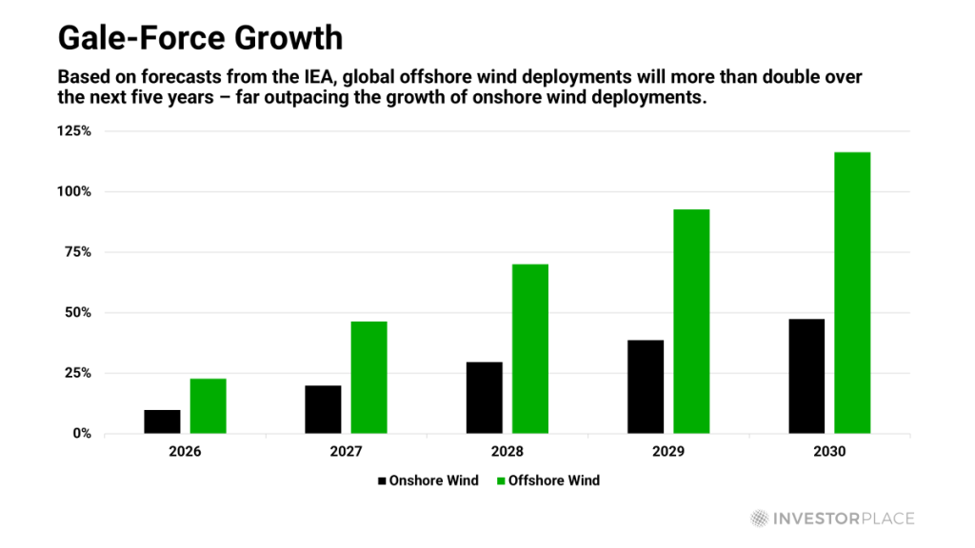
But within that overall wind story, offshore is growing dramatically faster than onshore. And that fact deserves attention…
Open Water, Open Opportunity
By 2030, global onshore wind deployments will have grown a healthy 47%. But offshore wind deployments will have soared 116%. In other words, the two technologies are playing in the same league, but at very different speeds, as the chart below depicts.
The offshore story deserves a moment of its own, because it represents a step-change in the technology’s potential, rather than a simple continuation of existing trends.
Offshore wind turbines operate in a fundamentally different environment than their onshore counterparts. Winds over open water blow stronger, more consistently, and more predictably than winds over land.
A modern offshore turbine generates electricity roughly 40%-50% of the time, compared to 25%-35% for a typical onshore installation.
Some of the newest turbines are even taller than the Eiffel Tower – an engineering achievement that would have amazed Gustave Eiffel himself.
The cost story for wind broadly echoes the solar story, if less dramatically. Onshore wind costs have fallen 69% since 2010, making it today the single cheapest source of new electricity generation globally – cheaper even than solar in high-wind regions, at roughly $20-$33 per megawatt-hour (MWh) versus coal’s $102. And offshore wind costs are projected to fall a further 30%-40% by 2030 as the supply chain matures and installation techniques improve.
Because of the substantial cost declines, the economic argument for wind no longer relies on subsidies. In most of the world, it wins on price.
As a result, the same structural forces accelerating solar deployment are accelerating wind: AI data centers need power, and national economies crave secure energy supplies.
The economics have already shown that wind is the way forward. Now the question isn’t whether wind will grow – it’s whether you’ll be positioned when it does.
Here’s where I see the best opportunity right now…
The Investment Case Has Never Been Stronger
Energy security ambitions are particularly favorable for wind, because large onshore and offshore installations are inherently domestic assets. A distant conflict cannot disrupt their electricity output, and they generate electricity for decades once built.
Yes, the obstacles to growth are real, especially in the United States.
Additionally, supply chain constraints for nacelles (the housing that contains a wind turbine’s generator and other key components), towers, and blades remain a binding limitation in some regions. But the upward trajectory remains unmistakable. The U.S. may be tapping the brakes on wind energy, but the rest of the world is putting its foot on the accelerator.
That’s precisely why our approach focuses on the global picture, not just the domestic one.
At Fry’s Investment Report, our exposure through one of our renewable energy holdings spans the global wind value chain – turbine manufacturers, component suppliers, project developers, and utilities across dozens of markets.
With rising energy demand and the growing importance of securing supplies amid ongoing AI advancements and tense geopolitical situations, wind power stands out as a clear and promising investment option.
Learn how to access the name of our wind-focused investment, along with other strategies I’m pursuing in the highly promising energy sector.
Regards,
Eric Fry
5 Stocks Our Experts Predict Could Double In the Next Year
By submitting your email, you'll also get a free pivot & flow membership. A free daily market overview. You can unsubscribe at any time.