Legacy media faces a structural crisis that cannot be solved by simply greenlighting better television shows. Owning premium content means very little if a network does not control how that content physically reaches viewers. just acknowledged this harsh reality with a $22 billion cash-and-stock deal to acquire .
The headline numbers are aggressive, and the immediate market reaction reflects anxiety over the immense financial leverage required to close this deal. Look past the initial shock, though, and a clear survival strategy emerges. By taking ownership of the dominant connected-TV operating system, Fox Corporation transforms from a vulnerable content supplier into a powerful toll-collecting gatekeeper.
Traditional broadcasters have spent the last decade suffering from margin compression as cable subscriptions have dwindled and affiliate fees have dried up. Transitioning to streaming was supposed to be a life raft, but networks quickly found themselves paying massive distribution cuts to third-party hardware providers just to access viewers. This acquisition signals capitulation to a new industry rule. Content alone cannot survive without distribution control.
Swallowing the Debt to Secure the Future
The financial architecture of this acquisition requires Fox Corporation to stretch its balance sheet to the absolute limit. The company is executing the buyout at $160 per share, using a 60/40 cash-and-stock split, with $96 in cash and 0.9693 shares of Fox Class A common stock per Roku share. To fund the enterprise value, Fox Corporation is securing up to $12 billion in bridge financing and absorbing $8.3 billion in new debt.
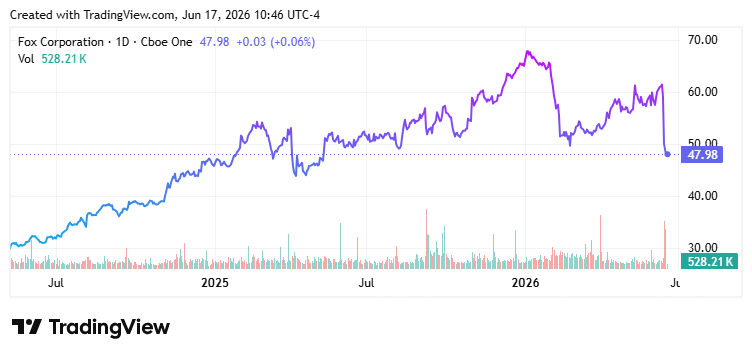
When Fox, with a $23 billion market capitalization, purchases a target valued at $22 billion, FOX shareholders are forced to absorb significant equity dilution. The market reaction was swift and punishing. Fox Corporation shares collapsed 17% on heavy volume following the announcement. Institutional investors immediately repriced Fox to account for a post-deal net leverage ratio of 2.8x trailing 12-month EBITDA.

Valuation friction also plays a major role in the sell-off. Fox trades as a mature value play with a price-to-earnings ratio of 14, while Roku trades purely on growth metrics with a towering price-to-earnings ratio of 105. Fusing a legacy cash-flow generator with a high-multiple growth asset creates a complex valuation model that institutional bases often reject in the short term.
Corporate insiders at Roku clearly anticipated this valuation ceiling. Key executives executed a concentrated wave of share liquidations just before the merger announcement. CEO Anthony Wood sold 18,000 shares on June 12, 2026, followed by significant sales from Director Mai Fyfield on June 13, 2026. The strategic timing indicates Roku executives aggressively locked in peak valuations before the cash-and-stock conversion was finalized.
Despite the near-term pain for Fox Corporation shareholders, the debt load is a highly calculated capital expenditure. Management projects $400 million in run-rate cost savings and models the transaction to be accretive to free cash flow per share by the second full year following the anticipated 2027 close. Paying a premium to secure a 100-million-household hardware ecosystem is the cost of permanently escaping the decay of linear television.
Forging the Ultimate Streaming Monopoly
Fox Corporation already controls Tubi, a rapidly expanding platform in the free ad-supported streaming television sector. Integrating Tubi with The Roku Channel creates an unprecedented digital advertising inventory pool. Management plans to keep the two platforms operating as separate consumer-facing applications, a smart operational move that exploits a minimal 33% audience overlap.
The true economic value is unlocked behind the screen. By merging datasets and ad-tech infrastructure, Fox Corporation captures a dominant share of the free streaming market across global endpoints. Owning the hardware layer allows Fox to weaponize the user interface. When a viewer powers on a Roku television, Fox can dictate the visual real estate. The operating system can be programmed to natively push Fox Sports, Fox News, and Tubi content before competing applications load.
This prioritization guarantees viewership for internal Fox Corporation properties and drastically reduces the customer acquisition costs that plague standalone streaming services. A unified data ecosystem also allows Fox Corporation to track consumer behavior from the moment a television turns on to the second a viewer powers down, creating a highly targeted advertising profile that commands premium ad rates.
Forcing Advertisers to Pay the Toll
Roku built an empire by operating as a neutral territory. Roku acted as an agnostic aggregator, routing viewers to various streaming apps while taking a standard cut of ad inventory. That neutrality ends the moment the acquisition closes.
Transitioning the living room operating system into a walled garden designed to amplify Fox Corporation’s inventory completely disrupts the ad-supported streaming ecosystem. Advertisers and media agencies rely on unbiased auction environments to deploy capital efficiently. If Roku backend ad-bidding logic shifts to favor Fox Corporation network properties, ad buyers will naturally look for alternative platforms to ensure fair market pricing.
This structural shift creates massive tailwinds for independent programmatic operators. Companies operating as independent demand-side platforms and supply-side platforms offer a neutral ground for ad buying and selling. Operators like and are structurally insulated from these emerging content conflicts. As the newly consolidated Fox Corporation ecosystem raises the toll for living room access, programmatic advertising budgets will systematically migrate toward the remaining agnostic infrastructure.
The Hunt for Neutral Ad-Tech Winners
The combined Fox Corporation and Roku entity instantly becomes the third-largest player in U.S. television by viewing share. This consolidation removes the last major independent hardware operator from the board, leaving the sector entirely controlled by legacy media and mega-cap tech conglomerates.
Wall Street analysts are rapidly updating models to reflect this reality. Several firms downgraded Roku to market perform ratings, citing capped upside at the $160 buyout price. Conversely, a select few analysts raised their price targets slightly, pricing in the remote possibility of a competing bid from a tech giant willing to absorb the termination fee to prevent Fox Corporation from controlling the living room gateway.
Holding legacy linear broadcasters that lack a dedicated distribution arm now carries immense structural risk. Successful navigation of this market requires identifying which ad-tech firms and streaming platforms can thrive when independent hardware no longer exists. Investors looking to capitalize on shifting advertising budgets may want to add independent programmatic ad-tech operators to watchlists as the connected-TV ecosystem adjusts to the newest gatekeeper.
5 Stocks Our Experts Predict Could Double In the Next Year
By submitting your email, you'll also get a free pivot & flow membership. A free daily market overview. You can unsubscribe at any time.