That is the SpaceX debut in one frame. Scarcity was not a footnote. Scarcity was the product.
Of course, none of this should come as any surprise to anyone who has followed the Korean café crypto crowd over the years. These are traders who have repeatedly moved markets en masse with almost surgical technical precision, often for extended periods, and almost always with obscene leverage turned up to a level that would make most risk managers reach for the defibrillator.
Frankly, the risk appetite is unmatched anywhere in the world. Korea does not do speculative momentum in half measures. When the crowd locks onto a theme, it does not quietly accumulate. It mobilizes. It piles in. It turns the trade into a national liquidity event. Risk management? In that corner of the market, the joke has always been that it feels almost illegal to even learn what the phrase means.
Takeaways
-
Of course, Korean retail bought SpaceX. This was never going to be a calm, valuation-sensitive, spreadsheet-driven entry point. It was a scarcity riot with a ticker.
-
The $800 million first day flow matters because it shows blocked IPO demand did not disappear. It simply reappeared in the secondary market with less patience and more urgency.
-
SpaceX is now trading less like a company and more like a global growth totem for space, AI infrastructure, defence relevance and sovereign-scale technology.
-
Korea is the perfect pressure gauge because its retail base already has deep muscle memory around the Elon premium through Tesla.
-
The trade can keep levitating while underallocated money is still chasing access, but at $2.65 trillion, valuation gravity is no longer a theory. It is the atmosphere.
SpaceX Draws $800 Million From Korean Investors on Trading Debut
Well, of course they did.
The same momentum kamikazes who will happily lever the family silver to buy deep out of the money calls on the most violent story stock in the market were never going to sit on their hands while ripped through the atmosphere without them. Lock them out of the IPO, ration the golden tickets, let the stock gap higher, and then act shocked when the Korean retail battalion charges into the secondary market like someone just rang the last boarding call to Mars. That is not a surprise. That is exactly what happens when scarcity, celebrity, leverage and fear of missing out get wired into the same trade.
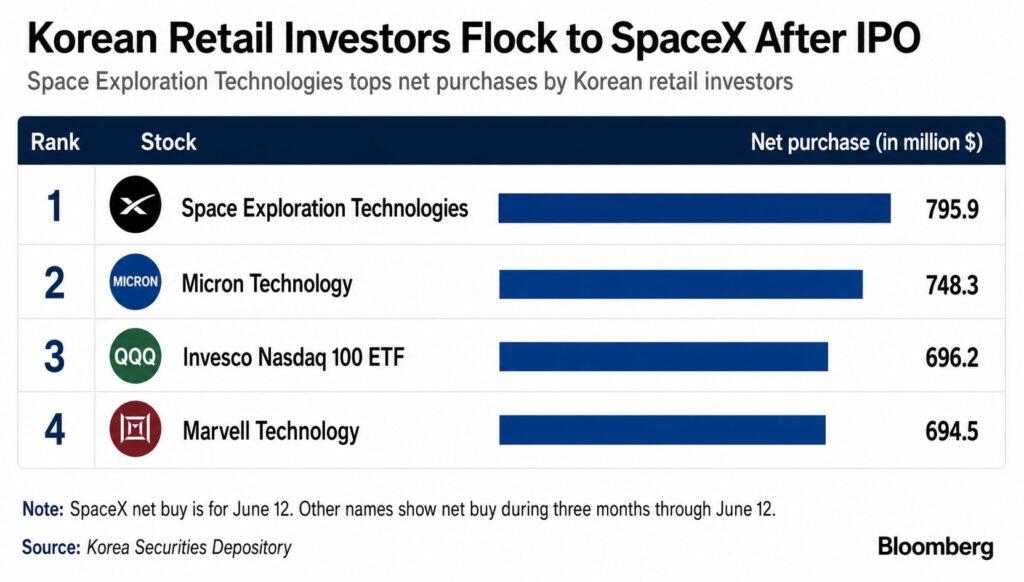
Nearly $800 million of Korean retail net buying hit SpaceX on its first trading day. Not over a month. Not over a quarter. One session. That single burst made SpaceX the most popular US stock among South Korea’s army of more than 14 million individual investors, and it tells you this debut was never just about another mega cap joining the board. SpaceX came to market as a new financial religion, and Korean retail arrived at the altar with both hands on the buy button.
The irony is that Korea’s retail crowd was largely shut out of the IPO itself. Japan and Australia had direct routes into the offering, but Korean investors did not. Mirae Asset had floated access for selected clients, only to walk away with no shares, and now the local regulator is inspecting the wreckage. In plain trader language, the primary market valve jammed, the demand pressure built behind it, and the first day of trading became the release hatch. When investors are denied access at the launchpad, they do not suddenly become patient valuation tourists. They chase the contrail.
That is the real lesson here. Demand blocked in the primary market does not disappear. It migrates. It waits. Then it comes back in the secondary market with worse manners, less price discipline and a much bigger sense of grievance. Korean retail did not ease into SpaceX. They stormed it. They treated the open like the last rocket leaving Earth.
And why not? SpaceX is already up nearly 50% since listing, pushing its market value toward $2.65 trillion and putting it ahead of Amazon by a whisker. At that altitude, investors are not buying a normal equity claim. They are buying the full mythology stack. Rockets. Satellites. Artificial intelligence adjacency. Defense optionality. Sovereign scale technology. Elon premium. Scarcity. Index destiny. The whole thing trades like a multi-trillion-dollar call option on the next decade, with enough narrative oxygen to keep the crowd breathing even when valuation starts getting thin.
Korea was always going to be fertile ground for this trade. This is a retail market that has already internalised the Musk premium through . South Korean individuals hold roughly $25.9 billion worth of Tesla exposure, so the emotional wiring was already installed. Tesla was the first chapter. SpaceX is the sequel with bigger engines, higher stakes and less room for hesitation. If Tesla was the road to the future, SpaceX is the attempt to securitise the sky.
You could see the pressure building before the stock even opened. A SpaceX-exposed exchange-traded fund had already pulled more than $300 million from Korean retail over the prior month. That was the waiting room trade. The proxy. The holding pattern. But once the real thing became tradable, the money moved straight to the source. That is how scarcity trades work. The substitute only works until the trophy asset appears on screen.
The comparison with other US favourites makes the signal even cleaner. attracted about $748 million of Korean retail net buying over three months. A fund pulled just under $700 million over the same period. SpaceX beat both in one day. That is not a rotation. That is a siren. Semiconductors give investors the AI picks and shovels. Nasdaq gives them the broad growth basket. SpaceX gives them the cleanest expression of frontier capitalism, with rocket engines strapped to the cap table and a global retail crowd desperate not to miss the next icon.
From a trader’s seat, the IPO pop is already yesterday’s story. The real question is what kind of flow ecosystem now forms around this monster. A company this large, this emotional and this scarce does not trade like a normal stock. It becomes a weather system. Active managers will have to explain why they own it, or why they missed it. Retail platforms will have to absorb the chase. Options desks will eventually turn the narrative into gamma, skew and dealer positioning. Every dip becomes a referendum on belief. Every rally drags another wave of tourists toward the launchpad.
The risk is just as obvious. When a stock becomes a symbol, valuation starts carrying more emotional freight than any spreadsheet can comfortably hold. A near-50 % rise out of the gate at a multi-trillion-dollar valuation means the market is not simply pricing in growth. It is pricing dominance. It is pricing execution perfection. It is pricing scarcity as if scarcity is a permanent asset class. That works while the bid is hot and underallocated money is still chasing access. But the higher the rocket climbs, the thinner the air becomes.
For now, though, the flow is the fact. Korean retail has given us the cleanest read on what SpaceX has become. It is no longer just an IPO. It is a global trophy asset sitting at the intersection of space, AI infrastructure, defence relevance, celebrity capital and retail muscle memory. Shut investors out of the launch, and they will buy the plume. Give them a stock that looks like the bridge between the future and the next index rebalance, and they will not wait for a polite entry point.
That is the SpaceX debut in one frame. Scarcity was not a footnote. Scarcity was the product.
5 Stocks Our Experts Predict Could Double In the Next Year
By submitting your email, you'll also get a free pivot & flow membership. A free daily market overview. You can unsubscribe at any time.