SpaceX IPO: The Hype Is Real, But History and the Filings Suggest Caution
is one of the most anticipated IPOs in history — 4x oversubscribed, Elon Musk’s superstar status, and a $1.75 trillion valuation that has everyone talking. Retail investors have the chance to buy shares, and the excitement is palpable.
I would dearly love this IPO to be different. Musk’s following and the company’s genuine achievements in space and Starlink give it a unique aura. But after reviewing the full set of filings and studying past IPO behaviour — particularly the Meta (Facebook) IPO chart — the merchant in me says: be very careful.
The Full Filing Picture Most Retail Investors Will Miss
Most coverage focuses on the original S-1 filed May 20, 2026. But SpaceX filed three more documents in quick succession:
- Amendment No. 1 (June 1)
- Amendment No. 2 (June 3)
- Free Writing Prospectus (June 5 — the day after the roadshow opened)
Reading only the original S-1 gives an incomplete picture. The full package reveals:
- Google Cloud Agreement: A major new deal for approximately 110,000 NVIDIA GPUs disclosed in the Free Writing Prospectus. This was not in the original S-1. It shows xAI is leasing significant compute from a direct competitor (Google Gemini and Google Cloud), introducing counterparty and termination risk that wasn’t reflected in the initial narrative.
- Financial Restatements: Amendment 1 retroactively incorporated xAI and X Holdings financials across all periods. The 2024 net income figures change materially depending on whether you’re looking at standalone SpaceX or the combined entity.
- Confirmed Pricing & Dilution: Amendment 2 locked in 555,555,555 Class A shares at $135, for a $75 billion raise.
This creates clear information asymmetry — institutions in the roadshow had the full picture, while many retail buyers relying on the original S-1 do not.
The Classic IPO Pattern – The Meta (Facebook) Example

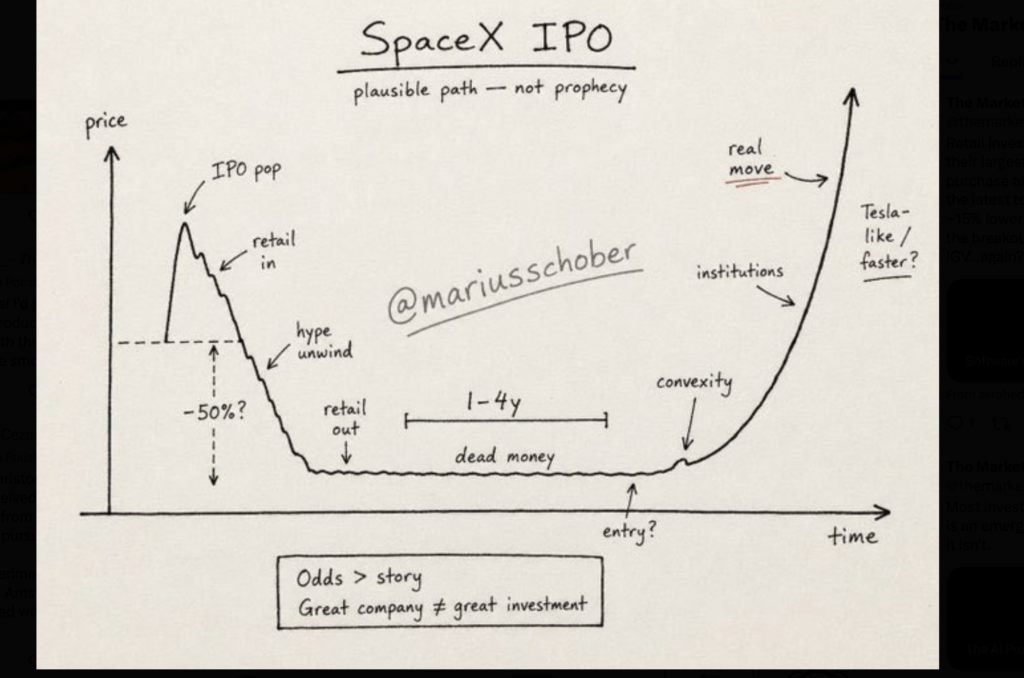
This hand-drawn chart, courtesy of @ThierryBorgeat, circulating on X captures the typical IPO trajectory perfectly. A real-world example is ’ 2012 IPO:
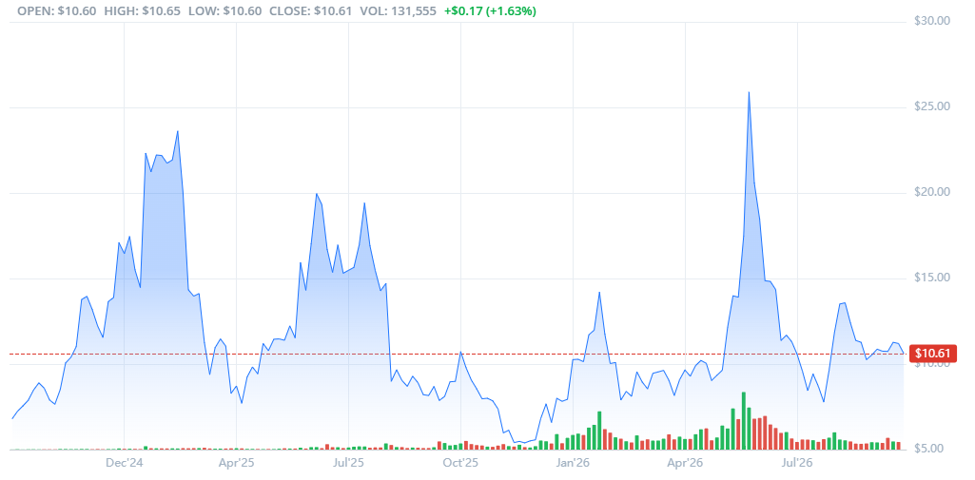
Meta launched at $38–$45 in May 2012, quickly fell to a low of $17.55 by September, and spent over a year in a range with limited price movement and classic high-volume narrow “Sumo” candles. A low-volume test in June 2013 confirmed the end of the accumulation phase before the eventual strong uptrend.
This pattern — initial pop on FOMO, sharp decline as hype unwinds, extended “dead money” period, then eventual recovery for those who wait — has repeated across countless growth IPOs. Retail often provides the exit liquidity for insiders and early investors.
Will SpaceX Be Different?
I want it to be different. Musk’s execution record, national security importance, and Starlink growth potential are real. However, at a $1.75 trillion valuation, there is simply too much at stake for market makers and large players to act against their instincts.
As the fable of the frog and the scorpion reminds us, it’s in their nature. Market makers will do what they always do in hyped IPOs — facilitate distribution at elevated prices. The multi-document filings showing last-minute material disclosures only reinforce the risk of post-IPO selling pressure.
Most likely path: Strong opening pop driven by retail enthusiasm, followed by a significant retracement (potentially 40%- 60%+), as hype unwinds and the Google deal and dilution are digested. Longer-term, if Starship and Starlink deliver, a Tesla-like recovery is possible. How long this would take is anyone’s guess. Facebook (Meta) took one year, Uber 4.5 years and Snapchat 3.5 years. However, one positive aspect of the SpaceX IPO is that Tesla took less than 5 months to recover to its IPO high.
VPA Perspective – What to Watch Post-IPO
Look for:
- High-volume narrow “Sumo” candles near the highs = potential distribution.
- Lower wicks on declining volume at support = absorption (possible early accumulation).
- Effort vs Result disharmony during the expected decline.
The real accumulation phase (if it comes) will likely appear much later, once the dead money period ends and fundamentals reassert themselves.
Final Merchant Thought
Great companies do not always make great short-term investments, especially at IPO. SpaceX has extraordinary long-term potential, but the structure of this offering — high valuation, insider selling window, and late-breaking disclosures — aligns with classic IPO dynamics.
We will track the charts closely using Multi-Dimensional VPA, combining volume price analysis with options flow, dark pools, and filing insights to separate the signal from the noise.
The intelligence and space race will create winners. But timing and price matter enormously.
VPA tells us WHAT is happening on the chart. Other sources tell us WHY.
What are your thoughts on the SpaceX IPO? Will it break the classic pattern or follow the Tesla/Meta playbook?
5 Stocks Our Experts Predict Could Double In the Next Year
By submitting your email, you'll also get a free pivot & flow membership. A free daily market overview. You can unsubscribe at any time.