Nasdaq rebounds after falling 4.5% on Friday
US futures are rising on Monday as chip stocks steady after plunging on Friday, although developments in the Middle East and expectations of tighter monetary policy could limit the upside.
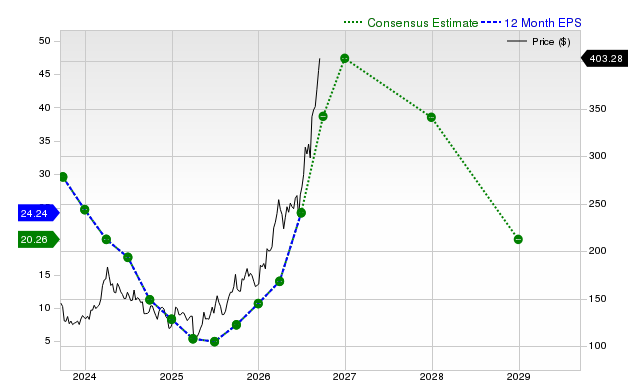
Shares in NVIDIA, Broadcom, and Micron Technology are higher, rebounding after a sharp sell-off on Friday that wiped almost $1 trillion from the market value of U.S.-listed chipmakers. The Philadelphia Semiconductor Index tumbled 10%, although the decline followed weeks of exceptional gains.
Expectations of tighter monetary policy, combined with underwhelming results from Broadcom last week, raised questions over the pace of the sector’s rally and prompted investors to take profits. This is by no means the end of the AI trade, but it does suggest that valuations had become stretched in parts of the market.
While AI optimism has helped Wall Street reach record highs, concerns over the Middle East and the impact of the conflict on inflation have clouded sentiment.
Oil prices and Treasury yields are edging higher after Iran and Israel exchanged strikes over the weekend, raising concerns that the conflict could become more prolonged as it passes the 100-day mark. However, sentiment has improved in recent hours after President Trump said that both Israel and Iran want a ceasefire, helping oil prices pull back from their session highs.
Friday’s non-farm payroll report reinforced the view that the Federal Reserve can remain focused on inflation. Attention now turns to this week’s CPI and PPI reports ahead of next week’s FOMC meeting. Stronger-than-expected inflation data could reinforce expectations that interest rates will remain higher for longer.
Corporate movers
Marvell Technology is up almost 9% after announcing that it will join the S&P 500. The stock had already surged last week after NVIDIA CEO Jensen Huang said Marvell, a key player in AI infrastructure, could become the next trillion-dollar company. The semiconductor firm will officially join the index on June 22.
Nasdaq Forecast – Technical Analysis

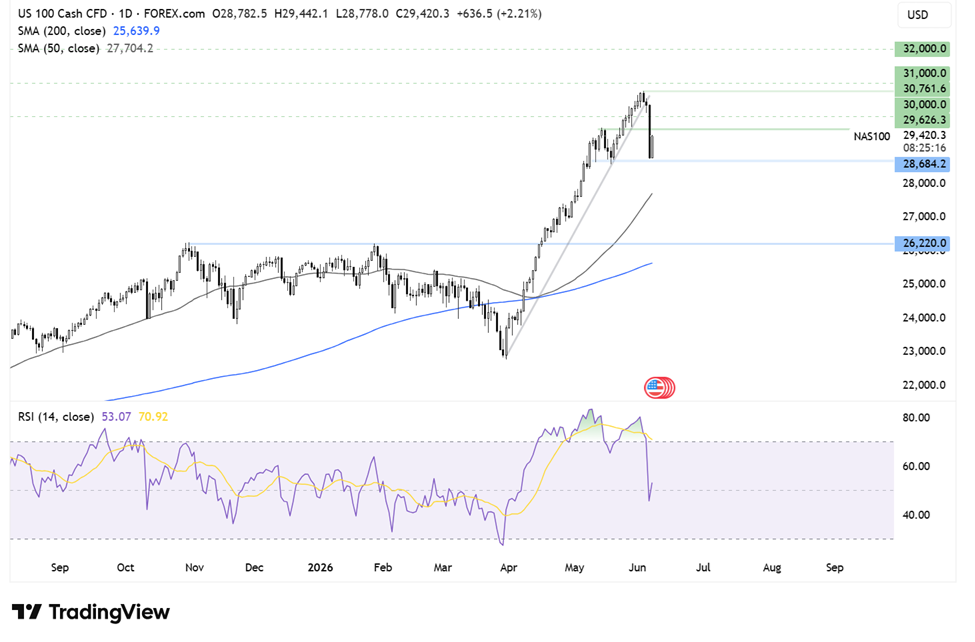
The Nasdaq 100 ran into resistance at a record high of 30,750 before pulling back, breaking below rising trendline support and finding support at 28,730, the May 19 swing low. The move has brought the RSI out of overbought territory.
Buyers will need to extend the recovery above 29,600 to regain momentum and target 30,000 and fresh record highs.
Sellers will need to break below 28,700 to extend the decline towards the 50 SMA at 27,700 and then 26,200, the 2025 high. A break below this level would negate the broader uptrend and expose the 200 SMA at 25,600.
FX markets – USD falls, EUR/USD rises
The U.S. dollar is easing after strong gains last week, although elevated oil prices and resilient U.S. economic data continue to support a more hawkish Fed outlook. The dollar could strengthen again if this week’s inflation data come in above expectations.
EUR/USD is rising as the weaker dollar offsets disappointing German data. German factory orders fell 3.8% month-on-month in April, worse than the 2% decline expected. The data follow weak PMI readings last week and come ahead of Thursday’s ECB rate decision, where policymakers are expected to raise interest rates.
GBP/USD is also rising as the weaker dollar supports the pair after losses last week. However, gains could be limited after Bank of England policymaker Alan Taylor suggested interest rates may remain on hold unless economic conditions deteriorate sharply. This contrasts with a Federal Reserve that is sounding increasingly hawkish following recent U.S. data.
Oil rises on renewed Middle East tensions
Oil prices jumped more than 4% on Monday after renewed hostilities in the Middle East reduced hopes of a near-term resolution and the reopening of the Strait of Hormuz. Prices have since eased from their highs after President Trump said both Israel and Iran wanted a ceasefire.
The conflicting headlines have created significant volatility at the start of the week. However, with shipping flows through the Strait of Hormuz still restricted, oil prices remain well supported.
Brent crude has risen 34% since the conflict began 100 days ago, while WTI is up 41%.
Meanwhile, OPEC+ agreed to a fourth output increase in as many months. However, the decision has had little impact on prices because disruptions linked to the Strait of Hormuz continue to dominate the supply outlook.
5 Stocks Our Experts Predict Could Double In the Next Year
By submitting your email, you'll also get a free pivot & flow membership. A free daily market overview. You can unsubscribe at any time.