Energy is the lifeblood of the artificial intelligence (AI) revolution. It’s no secret that AI infrastructure and workloads require up to 10X more power than traditional data centers. Data centers will consumer up to 12% of all electricity generated in the United States by 2030. There is a very real need to find new sources of localized power generation.
While small modular reactors (SMRs) sound like a great solution, the reality of permits and approvals is still years away. Bloom Energy Co. () is now providing a viable solution.
Here’s Why Coal is Being Canceled Out
Coal has been getting phased out as an energy source due to its carbon emissions, as the clean energy movement seeks cleaner solutions. Coal is viewed as inefficient. The basic process is to burn coal powder to generate heat, which boils water in a boiler, releasing steam that rotates the turbines and generates electricity. Thermal efficiency measures how much of the heat is actually used for electricity generation. For coal, it’s around 34%.
The Fallacy of Nuclear Energy and the Thermal Efficiency Factor
There is a misunderstanding that nuclear energy is much more efficient. Nuclear energy is made the “old-fashioned way”. The nuclear fission process is very similar to coal, where uranium-filled fuel rods are used to boil water, generating steam that turns turbines to generate electricity is zero carbon dioxide (CO2) and greenhouse gases (GHG) released in the process.
However, the thermal efficiency is around 37%. Bloom Energy Servers Transform into Electricity

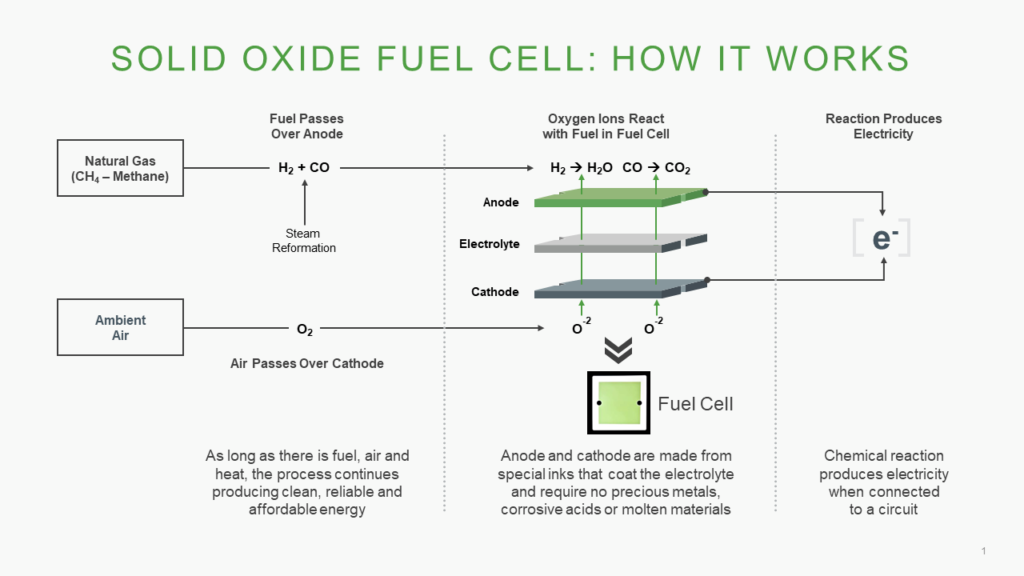
By using solid oxide fuel cells (SOFCs), Bloom Energy Servers convert natural gas directly into electricity. This alone has a thermal efficiency of 60%. During the electrochemical process, temperatures can rise to 1500 degrees Fahrenheit. An optional heat transfer system can repurpose waste heat to generate steam, as in nuclear power. This adds another 20% to 25% to the thermal efficiency, bringing the total to nearly 80-85%, which is more than coal and nuclear combined. Bloom Boxes can be stacked in sets of 325 kW each.
The main advantage for data centers is the time to power: from signing a contract to flipping on a microgrid, it can be just 4 months. This is why Oracle Co. () has committed to procuring up to 2.8 GWs of solid oxide fuel cells for its data centers.
Bloom Energy’s Q1 Earnings Blew Away the Analyst Estimates
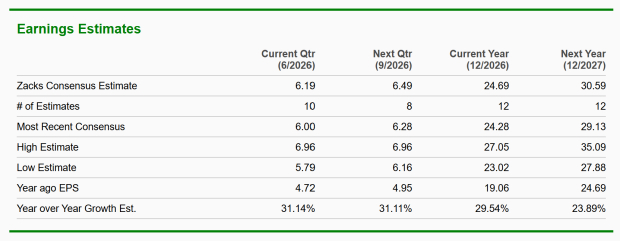
For its first quarter 2026, reported earnings-per-share (EPS) of 44 cents, crushing analyst estimates of 12 cents by 32 cents. Revenues surged 130.4% year-over-year (YoY) to $751.1 million, also crushing consensus analyst estimates of $539.94 million.
Bloom Energy Raised Full-Year 2026 Top and Bottom-Line Guidance
The Company raised its full-year 2026 guidance, with EPS of $1.85 to $2.05 (mid-point of $1.95), up from previous estimates of $1.33 to $1.48, versus consensus analyst estimates of $1.42. Revenues are expected to be between $3.4 and $3.8 billion (midpoint of $3.6 billion), up from $3.1 to $3.3 billion, versus consensus analyst estimates of $3.24 billion.
Bloom Energy shares can move with the .
BE Stock Has Potential Upside to $335 per Share

BE has been in a solid weekly uptrend, but it has formed a market structure high (MSH) sell trigger at $265.39. This is the trap door that could push the shares back down to the 15-week simple moving average (SMA) level. However, a weekly candle close above the market structure high at $302.99 can trigger a short squeeze.
The stochastic is currently overbought, so a pullback under the 80-band will enable it to cool off before accelerating to the upside, which could be around $335.00, the highest analyst price target.
Watch For More Deals To Boost Its Shares
While Oracle has taken the plunge with Bloom Energy, many more hyperscalers are showing interest. American Electric Power Company Inc. () is a major U.S. electric company that originally agreed to procure 100 MW of Bloom’s SOFC. In 2026, they exercised their option to purchase another 900 MW, bringing the total to 1 GW, enough to power over 870,000 homes for a year. AEP also serves major hyperscalers, including Microsoft, Alphabet Inc, Amazon Inc. and Meta Platforms Inc.
Written by,
Jea Yu, Analyst
Sigmanomics
With over 25 years of investing, analysis and trading experience in the equities and options market, Jea brings layered insights into the mechanics of how markets and trends operate. Jea is a four time published author with finance books focused on trading and risk management published by McGraw-Hill, John Wiley & Sons and Bloomberg Press. Jea has written over 2,500 articles across various digital platforms spotlighting and highlighting stocks, trends and trading strategies.
5 Stocks Our Experts Predict Could Double In the Next Year
By submitting your email, you'll also get a free pivot & flow membership. A free daily market overview. You can unsubscribe at any time.