Semiconductor stocks are up 70% in six weeks. Here’s what happened the last two times markets looked like this.
Hello, Reader.
Tom Yeung here with today’s Smart Money.
Two weeks ago, Canadian hydrologist Darri Eythorsson reported that he had built an AI trading platform in just six days.
“I am telling you this because it terrifies me,” he wrote in a widely viewed opinion piece on Bloomberg. “I have a Ph.D. in Arctic environmental science. I have never traded anything in my life.”
By using Anthropic’s Claude Code, Eythorsson had vibe-coded a system that “five years ago, would have been the core intellectual property of a funded fintech startup with a team of eight.” The platform takes news from RSS feeds, web searches, Reddit, and Twitter, and then trades that information on three financial exchanges.
Now, I do believe his algorithm is very successful. News and social media often predict stock market returns. In fact, I hope he continues making money; Ph.D.s don’t get paid nearly enough for the work they do.
But I am worried, too… for an entirely different reason.
You see, Eythorsson was concerned about how easy it was to throw together an AI trading platform. If he could do it, then what stops others from doing the same? He fretted that trading bots like his could soon take over financial markets.
Meanwhile, I’m alarmed because I know how these algorithms work.
I’ve built several of them myself, and the success of Eythorsson’s specific approach means we’re entering a manic phase of stock markets where hype and attention matter more than the fundamentals.
That’s why, today, I’d like to consider the dangers of the latest AI mania – and the smarter investing path to follow instead.
AI’s Hottest Trade Is Overheating
It’s been a wild two months for semiconductor stocks – the companies at one bottleneck of the AI Revolution. Data centers require immense numbers of chips, and global production is simply not enough to meet demand.
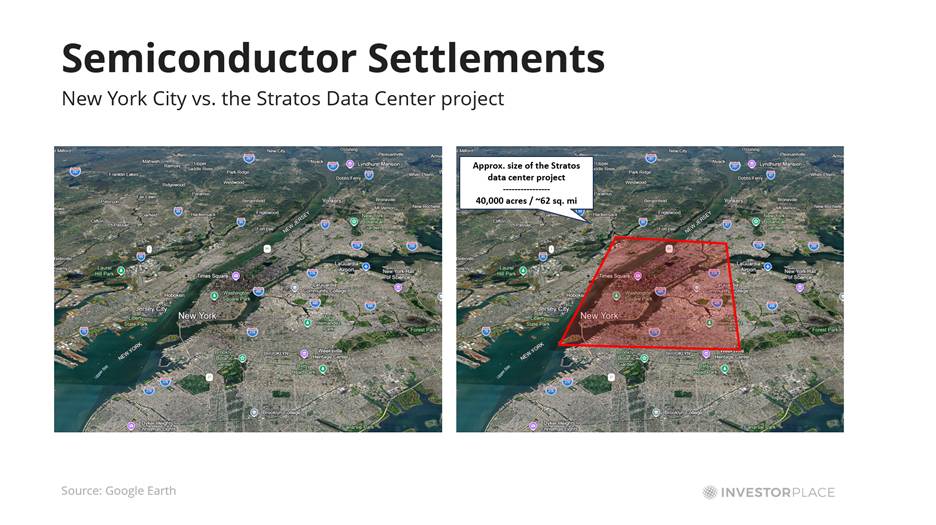
To illustrate, on the left is a picture of Manhattan, a 23-square-mile island and home to 1.66 million people, around half the population of Utah. And on the right is an overlay of Shark Tank star Kevin O’Leary’s “Stratos” proposal, a 9-gigawatt AI data center planned for Box Elder County, Utah.
The roughly 62-square-mile project would be almost three times the size of Manhattan and consume four times more power than its residents currently use.
More shockingly, Stratos is only one of several hyperscale data centers planned over the next several years. Meta Platforms Inc. (META) is currently constructing a 5-GW data center called Hyperion in Louisiana, while SoftBank Group Corp. (SFTBY) and the Department of Energy recently co-announced a 10-GW site in Ohio.
Each of these ambitious projects will need miles of server racks, stacked with thousands of chips each. And those chips will need to be replaced almost as soon as they’re installed, because GPUs only have a lifespan of five to seven years.
Imagine filling every square foot of your house with computers… then doing that another 968,000 times… and then doing it all over again every time your smoke alarm is due for replacement.
That’s proved a bonanza for chipmakers and memory makers, where supply simply cannot keep up with demand. It’s also turned Wall Street into a casino where anyone betting on chipmakers seems to win.
Over the past six weeks, prices of the semiconductor stocks, as measured by the iShares Semiconductor ETF (SOXX), rose as much as 70% before this week’s earlier selloff. That rise has included both solid players like Nvidia Corp. (NVDA) and wildly inconsistent ones like Macom Technology Solutions Holdings Inc. (MTSI), a firm that managed to lose $54 million in 2025 despite roaring demand.
We know this trend has been increasingly driven by retail investors.
That’s why it doesn’t surprise me that hydrologist Eythorsson’s algorithms have reportedly worked so well. Research has shown that investor sentiment can help predict next-day stock moves, especially during retail trading frenzies like the one in January 2021 that sent GameStop Corp. (GME) and AMC Entertainment Holdings Inc. (AMC) soaring into the spotlight.
The same forces are now pushing prices of semiconductor stocks to mad heights…
AI Mania Is Starting to Look Dangerous
Shares of Intel Corp. (INTC) now trade at roughly 100X forward earnings and 10X price-to-sales – higher even than during the dot-com peak. Macom (the one that lost $54 million last year) now trades at roughly 60X forward earnings.
“Semis are getting silly and are now in some cases as or more extreme than 1999,” Chris Verrone, head of technical and macro strategy at Strategas Securities, said in a note to clients. “Parabolic charts can take a life of their own and we don’t pretend to know the day or the hour fortunes reverse.”
However, we all know that 1999 and 2021 both ended poorly for speculators. Momentum alone cannot justify sky-high prices, and “silly” prices have a habit of coming back down hard.
GameStop’s stock nose-dived after hitting its all-time high in late January 2021, and shares remain 80% below that. Cisco Systems Inc. (CSCO) took 25 years to re-achieve its dot-com peak.
That’s why it’s essential to stay away from stocks with large downside. And why both Eric and I are hesitant about jumping in on the semiconductor craze. We’re seeing valuations where it is possible for stocks to lose 50% or more on sentiment alone.
Instead, Eric recommends a category of AI investing called “AI Survivors.” These “future-proof” enterprises produce goods and services that AI cannot replicate or replace.
Examples would include companies that operate in major industries like…
- Agriculture
- Energy in its various forms
- Mining
- Hospitality and travel
They are about as far as you can get from the AI mania. Therefore, they provide a margin of safety that’s becoming increasingly important in this frothy market.
Artificial intelligence also continues to consume far more resources than anyone anticipated. Chips remain in short supply, and industries like memory and hard drives are now controlled by only a few companies after years of industry ups and downs. The manufacturing process is now simply too complex for new competitors to enter the market.
So, when a reckoning comes – and it will – the results will wipe out years of performance.
The smarter play on AI isn’t chasing the stocks everyone already owns. Find out what Eric is recommending instead — at Fry’s Investment Report.
Click here to learn more.
Until next time,
Thomas Yeung, CFA
Market Analyst, InvestorPlace
5 Stocks Our Experts Predict Could Double In the Next Year
By submitting your email, you'll also get a free pivot & flow membership. A free daily market overview. You can unsubscribe at any time.