Early detection, I believe, is one of the smartest investments you can make, whether we’re talking about your portfolio or your health.
That’s why I recently made the decision to get a full-body MRI scan from Prenuvo and a multi-cancer blood test called Galleri, available from GRAIL.
The experience was eye-opening. In under an hour, the Prenuvo scan assessed my entire body using AI-enhanced imaging. No radiation or needles were necessary. The Galleri test, meanwhile, screens for a molecular “fingerprint” shed by cancer cells into the bloodstream before any symptoms appear.
Together, these two tests represent a new frontier in preventive medicine, one that could detect dozens of cancers years before they’d show up through conventional means.
I was so impressed by the experience that I mentioned both tests during my presentation last week at the Weiss Investment Summit in Boca Raton. Afterward, I was flooded with questions, and not just about the health implications but about the investment opportunities behind the technology.
Cancer Screenings Have Saved $5 Trillion. AI Could Multiply That
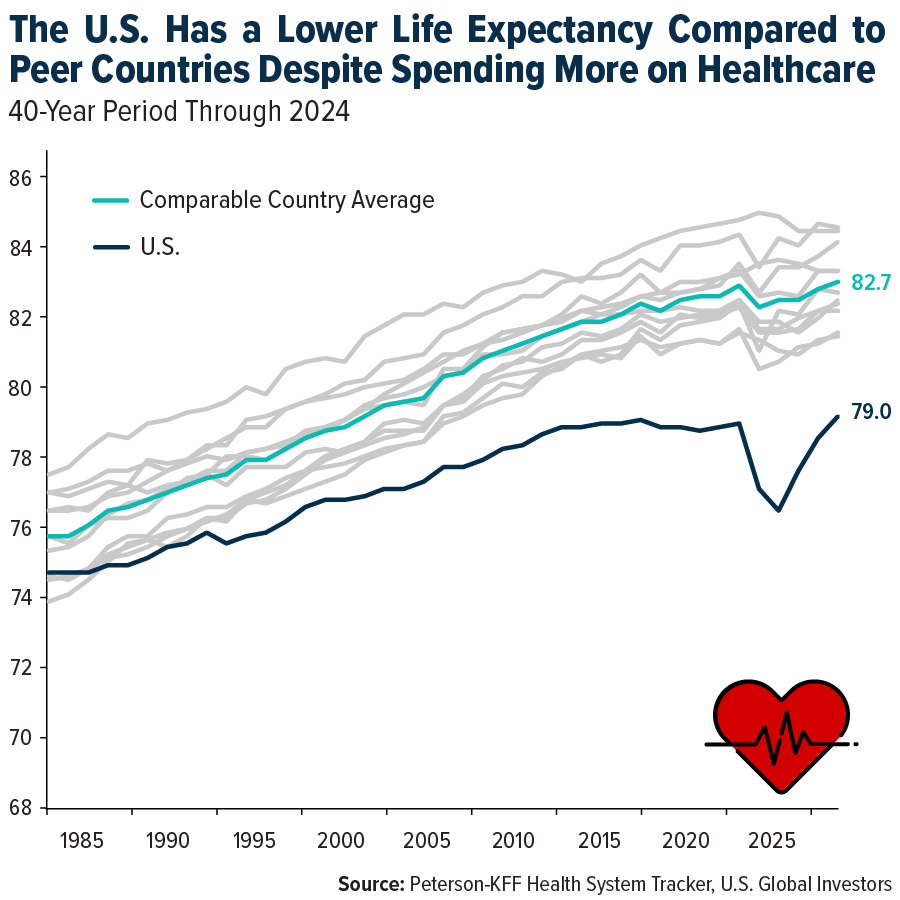
You may have noticed that healthcare in the U.S. doesn’t come cheap. In 2024, national health expenditures grew 7.2% to a staggering $5.3 trillion, or roughly 18% of . Despite spending nearly twice as much per capita as comparable nations, life expectancy in the U.S. sits at 79, nearly four years below the peer-country average.
In other words, we’re paying more and getting less.

Part of the problem is that our healthcare system is overwhelmingly reactive. We wait until people are sick before we intervene. But the data shows that finding diseases earlier is not just better medicine, it’s dramatically cheaper.
A University of Michigan study estimated that cancer screenings alone have saved the U.S. at least $6.5 trillion in economic value over the past 25 years, adding some 12 million years of life. This aligns with research out of England showing that early-stage cancer treatment averages about £11,200, while late-stage treatment runs to roughly £23,800, more than double the cost.
The results of early detection have been incredibly encouraging. The five-year survival rate for all cancers combined has reached 70% for the first time, a significant improvement from past decades.
It’s clear that early detection works, but the problem has been scale. That’s where AI enters the picture.
AI Beat ER Doctors at Diagnosis
The pace of AI adoption in medicine is accelerating faster than most people realize. The American Medical Association (AMA) reports that over 80% of physicians now use AI professionally, double the share from just 2023. Over three-quarters say AI provides a meaningful advantage in patient care, particularly in diagnostics and efficiency.
A landmark study published last month showed that OpenAI’s reasoning model outperformed physicians in a real-world clinical setting. At a Boston emergency room, the AI matched or exceeded human experts at every stage of patient evaluation. It was especially strong during initial triage, when information is scarcest.
Meanwhile, the Mayo Clinic found that an AI model called REDMOD can detect pancreatic cancer on routine CT scans up to three years before clinical diagnosis, identifying subtle tissue changes invisible to the human eye. In scans taken more than two years before diagnosis, the AI caught nearly three times as many early cancers as specialists reviewing the same images without AI assistance.
Everyday people are also using AI for medical purposes. Perhaps you’re one of them! A recent Gallup survey found that one in four Americans have used an AI tool for health information. Close to half say it made them feel more confident when speaking with their doctors.
Big Pharma Is Pouring Billions Into AI
For investors, the opportunity here is broad and, like AI in general, still very early.
GRAIL, the company behind the Galleri test I took, reported first-quarter 2026 revenue up 28% year-over-year, with Galleri test volumes surging 50%. The company is still operating at a loss—net loss was $93.2 million for the quarter—but the growth trajectory is hard to ignore.
Shares of the company tanked in February following reports its blood test wasn’t as effective as hoped for. But a trial of 6,000 patients in England found that a third of presumed false alarms from the Galleri test were later confirmed as cancer within 15 months, suggesting the test was detecting cancers before conventional methods could. GRAIL stock is now in recovery mode and trading above its 50-day moving average.

Prenuvo, which raised $120 million in funding last year, has secured FDA clearance for its AI-powered body composition analysis. It’s expanding beyond cancer screening into brain health and metabolic markers. The cost remains a barrier—scans run $2,500 to $4,500, and insurance doesn’t cover them—but as I said before, this is early-stage technology. Prenuvo is privately-held, with no current sign of any plans to tap public markets.
On the pharma side, is interesting. The Indiana-based company recently partnered with to build the most powerful AI supercomputer owned by a pharmaceutical company. Lilly is already using AI to optimize production of its blockbuster GLP-1 drugs, finding manufacturing efficiencies its human engineers thought were maxed out. Rival firm Roche is reportedly building an even larger supercomputer, while companies like GSK, AstraZeneca and Merck have announced billions of dollars in AI partnerships.
How AI Could Turn America’s Most Expensive Problem Into an Investment Opportunity
In a 2024 blog post, Anthropic CEO Dario Amodei predicted that AI will fundamentally change healthcare this century. Specifically, he believes we’ll be able to squeeze 50 to 100 years of biological and medical progress into just five to 10 years. He calls this the “compressed 21st century.”
That’s a bold claim, but when I look at the data on AI diagnostics, the trajectory supports it.
As I often say, government policy is a precursor to change. But sometimes technology is the precursor, and the market follows. Healthcare is one of America’s biggest money pits, and AI is the first tool I’ve seen with the potential to fundamentally repair it. I believe that makes it an investment theme worth following closely.
***
All opinions expressed and data provided are subject to change without notice. Some of these opinions may not be appropriate to every investor. By clicking the link(s) above, you will be directed to a third-party website(s). U.S. Global Investors does not endorse all information supplied by this/these website(s) and is not responsible for its/their content.
Holdings may change daily. Holdings are reported as of the most recent quarter-end. The following securities mentioned in the article were held by one or more accounts managed by U.S. Global Investors as of (03/31/2026): NVIDIA Corp.
5 Stocks Our Experts Predict Could Double In the Next Year
By submitting your email, you'll also get a free pivot & flow membership. A free daily market overview. You can unsubscribe at any time.