Nvidia’s (NASDAQ:) $500 million direct warrant injection into Corning (NYSE:) unequivocally confirms that physical optical bandwidth operates as the definitive bottleneck for next-generation artificial intelligence (AI) processing. Silicon architecture and graphics processing units can only calculate data as fast as the physical infrastructure allows it to transfer.
By weaponizing its accelerated Springboard plan to scale domestic photonics capacity, Corning Incorporated monopolizes the latency-critical layer of the hyperscale buildout. Corning stock immediately reprices from a cyclical industrial materials supplier to an indispensable, high-margin proxy for artificial intelligence infrastructure.
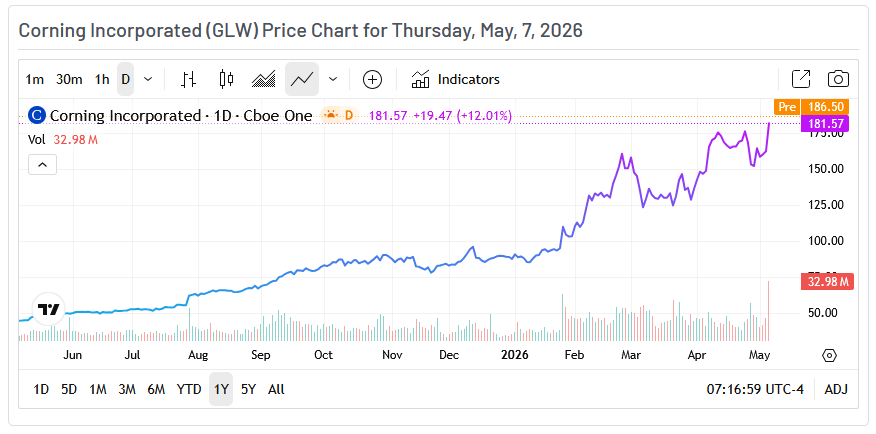
The market aggressively recognized this fundamental pivot during the May 6 session. Shares of the glassmaker eclipsed the $184 mark on immense volume, securing a more than 25% 30-day rally and extending year-to-date gains above 110%.
Shattering the consensus average price target of $150.31, the equity entered a decisive fundamental breakout driven by confirmed institutional capital allocation.
NVIDIA Footing the Bill: How Capital Injections De-Risk Growth
The hardware catalyst initiated when NVIDIA acquired a traditional warrant for 15 million shares at a $180 strike price, coupled with a pre-funded warrant for three million shares at a nominal $0.0001. The overarching contract structure features framework options permitting the semiconductor sector giant to deploy up to $2.7 billion in total capital. This direct financial intervention profoundly de-risks the massive domestic manufacturing expansion required to support modern data centers. Rather than funding speculative growth through expensive debt markets, Corning secures capital directly from its largest end-user.
Management is committed to building three new advanced manufacturing facilities across North Carolina and Texas, creating over 3,000 U.S. manufacturing jobs. These facilities are specifically engineered to expand U.S. fiber production capacity by more than 50% while scaling latency-sensitive optical connectivity capacity by a factor of 10. Modern data center workloads require unprecedented volumes of high-performance optical fiber and photonics to move data at speeds capable of supporting next-generation GPU clusters. Securing a buyer to fund and absorb the scaled output entirely protects the corporate balance sheet from the typical risks associated with massive infrastructure capital expenditures.
By weaponizing its accelerated Springboard plan to scale domestic photonics capacity, Corning Incorporated monopolizes the latency-critical layer of the hyperscale buildout. Corning stock immediately reprices from a cyclical industrial materials supplier to an indispensable, high-margin proxy for artificial intelligence infrastructure.
The market aggressively recognized this fundamental pivot during the May 6 session. Shares of the glassmaker eclipsed the $184 mark on immense volume, securing a more than 25% 30-day rally and extending year-to-date gains above 110%.
Shattering the consensus average price target of $150.31, the equity entered a decisive fundamental breakout driven by confirmed institutional capital allocation.
NVIDIA Footing the Bill: How Capital Injections De-Risk Growth
The hardware catalyst initiated when NVIDIA acquired a traditional warrant for 15 million shares at a $180 strike price, coupled with a pre-funded warrant for three million shares at a nominal $0.0001. The overarching contract structure features framework options permitting the semiconductor sector giant to deploy up to $2.7 billion in total capital. This direct financial intervention profoundly de-risks the massive domestic manufacturing expansion required to support modern data centers. Rather than funding speculative growth through expensive debt markets, Corning secures capital directly from its largest end-user.
Management is committed to building three new advanced manufacturing facilities across North Carolina and Texas, creating over 3,000 U.S. manufacturing jobs. These facilities are specifically engineered to expand U.S. fiber production capacity by more than 50% while scaling latency-sensitive optical connectivity capacity by a factor of 10. Modern data center workloads require unprecedented volumes of high-performance optical fiber and photonics to move data at speeds capable of supporting next-generation GPU clusters. Securing a buyer to fund and absorb the scaled output entirely protects the corporate balance sheet from the typical risks associated with massive infrastructure capital expenditures.
Cautious investors may prefer to wait for a technical pullback before forming a position, allowing elevated valuation multiples to stabilize ahead of upcoming quarterly delivery metrics.
5 Stocks Our Experts Predict Could Double In the Next Year
By submitting your email, you'll also get a free pivot & flow membership. A free daily market overview. You can unsubscribe at any time.