The time has come to make a move on this software-stock selloff. And we’re going to use (our favorite income plays, closed-end funds (CEFs), to do it.
That’s because the story here—that AI is going to harm the sector, cost jobs and hurt the economy as a whole—is the opposite of what’s really happening on the ground. And we’ve finally got some reliable data to prove it.
A CEF that’s well-positioned to tap this disconnect is a 7.8%-payer called the BlackRock Science and Technology Term Trust (NYSE:).
The fund’s total return popped 21% this year, but it still trades at a 9.3% discount to net asset value (NAV, or the value of its underlying portfolio). That’s right around where the discount stood back in January. Which is quite out of step for a run like this.
From Gloom to Optimism
You might remember that, back in February, a company called Citrini Research wrote a note saying that, essentially, AI was going to kill jobs and crater the economy. As a result of just this one note, markets tanked.
Shortly after, University of Chicago economist Alex Imas (and a few others) responded that Citrini’s logic was flawed and AI is unlikely to take jobs in the long term. Markets bounced.
It just goes to show how skittish this situation has made traders!
Fast-forward to today, and we now have signs that Imas was right, and, in reality, AI is creating jobs.

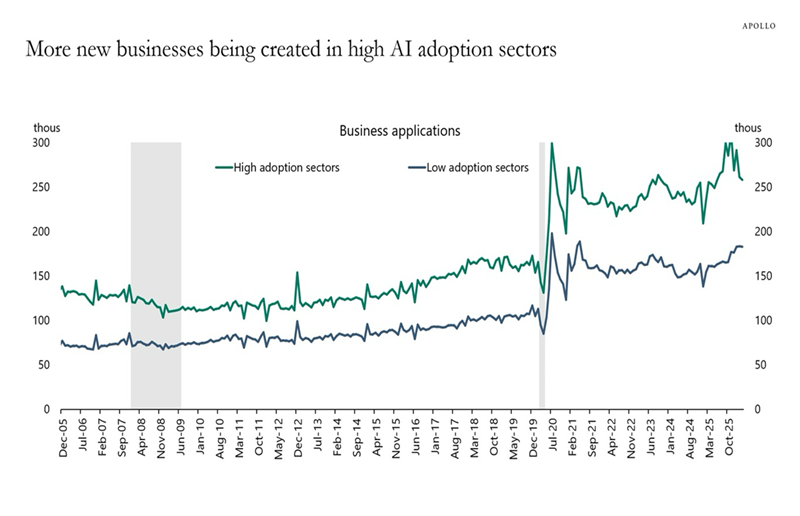
This chart from Apollo Global Management shows a dramatic rise in new-business creation, especially in sectors where AI is being adopted the most (the upper line, in green). The growth is much higher in this area than what we are seeing with low-adoption sectors (the lower line, in navy).
Also, it’s worth noting that both lines were moving solidly upward in 2025, suggesting that this is a positive trend for the economy as a whole.
These findings are backed by recent reporting in The Wall Street Journal saying there’s been a spike in new jobs being created by AI, both due to data-center construction and because of companies looking for people to work with the technology.
A more exciting, lesser-known report from LinkedIn adds more data supporting the optimistic case. That site’s chief economist, Karin Kimbrough, writes:
“Over the past two years, 1.3 million new AI-enabled jobs have emerged globally, although AI adoption is slow and skills remain concentrated to just a few job functions.”
The second half of that sentence is what really matters: AI is just getting started. More new jobs are coming, more productivity is going to be unlocked and, again to quote Kimbrough:
“This creates an opportunity for business leaders to play the long game now, by embracing change, building resilience, and investing in the most important skills to unlock growth.”
All of this, quite simply, tells us that the AI story is now the complete opposite of what it was just a month ago. Instead of jobs being stolen by robots, we’re now seeing AI starting to increase demand for workers.
And yet …
Software Stocks Remain in a Slump

A look at the iShares Expanded Tech-Software Sector ETF (NYSE:) tells us that, despite evidence that AI is good for software stocks, the sector is still on the mat. IGV is an ETF holding software-as-a-service (SaaS) companies and includes high-growth names like CrowdStrike Holdings (NASDAQ:) and Applovin (NASDAQ:), as well as blue chips like Oracle (NYSE:), Microsoft (NASDAQ:) and Palantir (NASDAQ:).
In other words, investors sold off these stocks because AI was supposedly going to wipe out demand for their products. Yet demand for the very people these firms need is on the rise, telling us demand for their products is, too.
Our Discounted 7.8% Income Play
IGV yields just 0.4% today, so it’s not something we income investors would use to invest in a “disconnect” like the one playing out in software stocks right now. But that low yield, in a strange way, works in our favor. That’s because many income investors, thinking it’s impossible to get meaningful income from tech, walk right past this story.
But here too, their thinking is just plain wrong.
Consider 7.8%-yielding BSTZ. It’s heavily invested in public and private AI firms, including data analytics firm Databricks, NVIDIA (NASDAQ:), Anthropic (maker of the Claude chatbot), Bytedance (provider of TikTok) and others.
The fund’s portfolio is a bargain in its own right: Private firms have been marked down by early 2026’s overdone selloff, while the tech sector as a whole faced another selloff in April, when concern about higher inflation sparked by the Iran conflict added another level of worry (tech stocks are particularly rate-sensitive).
Here’s the really interesting thing about BSTZ, though:
BSTZ’s Total Return Outruns Software, Stocks as a Whole …

As we can see from the fund’s total return (in purple above), investors are starting to realize their mistake, driving BSTZ well ahead of the fund (in orange) since the start of the year.
But the fund’s stubborn discount tells us this gain still hasn’t fully registered with investors:
… But the Fund Is Still Cheap

As you can see above (and as I mentioned off the top), even with the strong return the fund has posted this year, its discount is still wide—right around where it was at the start of the year. That puts more upside on the table as this markdown eventually closes.
And that 7.8% dividend—while it has moved around some in the last three years—is stable and right around where it was at the start of that period, with a nice special dividend kicked out at the end of December.
Tech Pays Lousy Dividends? Tell That to BSTZ

Source: Income Calendar
This leaves us with a dividend that is not only high, but has the potential to grow and give us additional one-time payouts, too. The fact that it’s paid monthly is a nice bonus, and makes this fund, and its income stream, even more of a rarity in the tech sector.
Disclosure: Brett Owens and Michael Foster are contrarian income investors who look for undervalued stocks/funds across the U.S. markets. Click here to learn how to profit from their strategies in the latest report, “7 Great Dividend Growth Stocks for a Secure Retirement.”
5 Stocks Our Experts Predict Could Double In the Next Year
By submitting your email, you'll also get a free pivot & flow membership. A free daily market overview. You can unsubscribe at any time.