If this manic market is making you queasy, I get it. So let’s talk about the perfect dividend payers for this volatility.
Those would be two funds throwing off 8%+ payouts we can collect in peace. And because both are cheap (for now), they have a higher “floor” on pullbacks than the does.
They’re both covered-call funds, and they’re built for market “tantrums” because:
- They offer 8%+ dividends that get us through a pullback without having to sell shares to get the cash we need.
- They hold well-known stocks: These funds hold familiar big caps with a twist: They “overlay” a portion of their portfolios with an option strategy that does best when uncertainty is high (more on that below).
- They’re cheap, because investors have been ignoring these volatility plays as the market rocketed out of its March lows. That makes now the time to buy, while we can still do so at a bargain.
As the name implies, these funds sell covered-call options on their portfolios, which is a lower-risk way to generate extra income.
This strategy involves selling the right to buy a fund’s stocks at a fixed future date and price. No matter how these trades play out, the fund keeps the fee, or “premium” it charges for these rights.
The strategy works great in a choppy market because, in addition to the premiums it charges, in many cases it keeps the underlying stock, as well, because it fails to rise to the target, or “strike,” price of the option trade.
The caveat? Covered-call selling can hold back gains in a rising market, as the fund’s best stocks are sold, or “called away.” We’re okay with that because the portfolio’s growth in such markets support these 8%+ dividends until volatility inevitably returns.
Let’s get into our two funds, which show this strategy in action:
A 9.2% Payer Selling for 11% Off
The Nuveen S&P 500 Dynamic Overwrite Fund (NYSE:) looks, on the surface, like the go-to S&P 500 index fund, the State Street SPDR S&P 500 ETF Trust (NYSE:).
All the benchmark index’s constituents are here, including tech giants (more on them below) like NVIDIA (NASDAQ:) and Microsoft (NASDAQ:), as well as kingpins from other sectors, like JPMorgan Chase (NYSE:) and Pfizer (NYSE:).
That’s where its resemblance to SPY ends, though, and SPXX’s option strategy kicks in. The fund sells call options on 35% to 75% of its portfolio, depending on market conditions. The premiums from these trades play a big role in supporting its payout, which is why SPXX yields nine times more than SPY: 9.2%, to be exact.
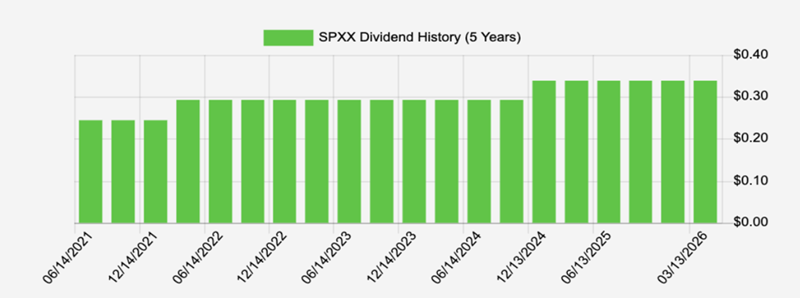
What’s more, that supersized payout has been growing, up 38% in the last five years:
SPXX’s 9.2% Divvie Is On a Tear

Source: Income Calendar
Now let’s talk value, because SPXX trades at an 11.4% discount to NAV as I write this, well below its five-year average discount of 3.6%. That means we’re essentially buying the S&P 500 for around 89 cents on the dollar. And that discount has been growing (we can thank today’s placid market for that):
SPXX Goes On Sale

As volatility picks up and more investors swap the “Y” at the end of “SPY” for an “XX,” I expect that discount to shrink back to its historical norm.
Now let’s diversify our S&P 500 (and tech) exposure with a more equally weighted (and worldly) covered-call fund.
A “Global” Covered-Call Fund Yielding 8.1% (That Pays Us Every Month)
The BlackRock Enhanced Equity Dividend Trust (NYSE:) is more or less balanced among sectors: Finance is the biggest, at 16.7% of assets. Tech follows, at 15.7%, with industrials at 14.6% and healthcare at 12.8%.
There’s global exposure here, too, with about 10% of the portfolio outside the US.
Let’s start with BDJ’s 8.1% dividend, which marched 32% higher in the last decade (not including special dividends, which the fund has paid five times in that span):
Source: Income Calendar
BDJ aims to invest 80% of its portfolio in dividend-paying stocks. It further bulks up the divvie by selling call options on its holdings (around 49% of its portfolio as of April 30). An added bonus: BDJ pays dividends every month, right in line with our bills.
As I write this, the fund trades at an 8.2% discount, well below its 5.6% average over the last five years. If that discount moves back toward 5.6%—as history suggests is likely when volatility returns—it would give the fund’s price an extra push.
Put it all together and we’ve got a nice two-fund combo that’s diversified, offers an 8.7% average dividend (with monthly payouts from BDJ) and comes our way at a discount. That gives us a sweet high-income “bridge” over whatever comes our way next.
Start With BDJ and SPXX—Then Add Monthly Dividends (Up to 14.9%)
Covered-call funds aren’t the only option CEFs give us for navigating the next downturn—and growing our income stream while we do.
These funds also give us plenty more options that pay dividends monthly—right in line with our bills.
Even better, when the market does fall out of bed, monthly payers give us extra peace of mind, rolling in every 30 (or 31) days, no matter what.
And I’ve got 3 monthly payers picked out for you that are among the best “win either way” plays I’ve seen. If the market soars from here, their deep discounts will close, propelling their shares higher.
If the market stalls, those same discounts give us a built-in margin of safety. And either way, we’ll collect their rich monthly payouts (up to 14.9%) in peace.
Disclosure: Brett Owens and Michael Foster are contrarian income investors who look for undervalued stocks/funds across the U.S. markets. Click here to learn how to profit from their strategies in the latest report, “7 Great Dividend Growth Stocks for a Secure Retirement.”
5 Stocks Our Experts Predict Could Double In the Next Year
By submitting your email, you'll also get a free pivot & flow membership. A free daily market overview. You can unsubscribe at any time.